
Working and sleeping in the same room used to mean you’d sacrificed something. Today, a bedroom office combo is a practical necessity for remote workers, students, and creatives who need functional space without buying or renting larger square footage. The key isn’t cramming a desk into a corner and hoping it blends in, it’s intentional design that lets both functions coexist without one overwhelming the other. Whether you’re working with a spare bedroom or converting a master suite, the right layout, furniture, and visual separation can turn a tight space into two fully functional zones that actually feel distinct.
Table of Contents
ToggleKey Takeaways
- A bedroom office combo requires intentional layout design with the bed and desk positioned on opposite or perpendicular walls to create distinct zones without physical barriers.
- Corner desks and wall-mounted solutions maximize floor space—corner setups tuck work into unused areas while fold-down desks offer reversible options perfect for guest rooms.
- Visual separators like bookshelves, curtain rods, or tall furniture divide zones effectively and can include functional elements such as storage and acoustic sound dampening.
- Dual-purpose furniture like storage beds and desks with built-in shelving consolidate functions and prevent small bedroom office combos from feeling cluttered or cramped.
- Layered, dimmer-compatible lighting with separate task lights for the desk and softer ambient lighting near the bed supports both work focus and sleep quality.
- Color, flooring, and decor—such as accent wall paint, area rugs, and minimalist vs. decorated sides—reinforce psychological separation between your work and rest areas.
Choose the Right Layout for Your Bedroom Office
Your layout is the foundation of everything else. Get this wrong, and no amount of clever decor saves you from a space that feels cramped or dysfunctional. The goal is to position your desk and bed so they don’t visually compete and traffic flow, your own movement through the room, feels natural.
Start by taking honest measurements. You need the length and width of your room, and note any fixed elements: doors, windows, heating vents, electrical outlets. If you’re working with less than 120 square feet, every inch matters. Most of the best combos put the bed and desk on opposite walls or perpendicular to each other, creating a sense of separation without needing a wall.
Corner Desk Setup
A corner desk is a space-saver’s best friend. It pulls your work area into an unused pocket of the room, typically the space behind an open door or an unused room corner, and keeps it visually distinct from the sleeping area. The desk doesn’t dominate the room because it’s tucked away, and you get an L-shaped work surface without taking up much floor space.
Measure your corner carefully. Standard desk depth is 24 to 30 inches: L-shaped corner desks often run 48 to 60 inches across. You’ll want at least 36 inches of clearance in front so your desk chair can roll back fully. If your corner has an existing outlet, that’s a huge win, no need to run power cords across the room.
Corner desks work best when the bed sits on an adjacent or opposite wall. This naturally zones the room: one corner is work, the other half is sleep. Lighting over the desk (more on that later) reinforces the separation.
Wall-Mounted Solutions
If floor space is at a premium, go vertical. A wall-mounted desk, often called a floating desk or fold-down desk, mounts directly to wall studs at a comfortable height (usually 30 to 36 inches from the floor to the work surface) and occupies minimal footprint when not in use. Some fold up completely: others are fixed but slender enough you barely notice them when you’re not working.
A solid fold-down desk typically handles 75 to 100 pounds when fully extended and locked. Confirm your walls can handle the load, if you have drywall only, you’ll need heavy-duty toggle bolts or molly anchors. Don’t skimp here. A desk collapsing mid-Zoom call isn’t the vibe.
The trade-off: wall-mounted desks are usually 20 to 24 inches deep and suit laptop or small-monitor setups better than sprawling dual-monitor rigs. They’re perfect for the room that doubles as a guest bedroom because you can close up the work zone entirely when guests visit.
Create Visual Separation With Design Dividers
You can’t wall off an office without losing the bedroom. Instead, use dividers, physical, visual, or both, to signal that the space shifts from sleep to work. The bed remains visible, but a divider breaks the line of sight from the door or from where you sleep, so the office doesn’t assault your eyes when you wake up.
Bookcases as room dividers work surprisingly well. A tall, narrow bookcase (36 to 48 inches wide, 60+ inches tall) positioned between the bed and desk acts as both storage and a visual barrier. It doesn’t block light or air like a solid wall, but it chunks the space into distinct zones. Stack books spine-out, and add a few plants or decorative objects to keep it from looking purely functional.
Curtain rods and fabric panels are the renter’s best friend. Mount a tension rod or curtain rod from the ceiling between the work and sleep zones, then hang a heavy linen, cotton, or acoustic curtain. You get full sound dampening (fabric absorbs noise better than air) and can draw it closed when needed. A 48-inch wide panel costs $15 to $60 depending on material: hardware is another $20 to $40. This is non-permanent, reversible, and you can take it with you.
Furniture-based separation also works: an open shelving unit, a tall dresser, or even a desk arrangement that faces away from the bed. These create logical boundaries without feeling like a hack. The key is height, anything under 36 inches tall doesn’t truly separate the zones, so aim for taller pieces when possible.
Select Dual-Purpose Furniture Pieces
Dual-purpose furniture isn’t about compromise: it’s about working smarter. A piece that does two jobs frees up floor space and keeps the room from feeling cluttered.
Storage beds (platform beds with built-in drawers) consolidate sleeping and storage into one footprint. Instead of a bed plus a separate dresser, you get both in one unit. Platform beds also sit lower to the eye, which makes small rooms feel less cramped. Quality ones cost $400 to $1,000, but you’re replacing two pieces of furniture, so the math is sound.
Desks with built-in shelving or storage do the same for your work zone. Many modern desks include hutch-style shelves above or beside the work surface, giving you file storage, monitor risers, and vertical space without adding floor clutter. A desk with integrated storage costs 20 to 30 percent more than a basic model but eliminates the need for a separate filing cabinet.
Wall-mounted shelving above your desk or behind your bed consolidates storage without eating into floor space. Floating shelves (24 to 48 inches wide, mounted to wall studs) add storage and display space that makes the room feel intentional, not squeezed. Ensure proper installation, small bedrooms ideas highlight the importance of secure wall anchors for safety and durability.
Extendable dining tables (48 to 72 inches when extended) can double as a large desk for sprawling work projects, then collapse to a small side table when you need floor space. Not the most elegant solution, but it works if you alternate between focused desk work and collaborative project spreads.
Optimize Lighting and Ambiance for Both Spaces
Lighting makes or breaks a bedroom office. Bad lighting either keeps you up at night or destroys your ability to focus on work. You need separate, controllable light sources for each zone so you can work brightly without blasting the bed with glare.
Task lighting at your desk is non-negotiable. A desk lamp with an adjustable arm (architect-style or swing-arm) gives you directional light that doesn’t spill into the rest of the room. Look for one with at least 400 to 500 lumens and a color temperature around 4000K to 5000K, cool enough to fight eye fatigue during screen work, but not so harsh it feels clinical. LED bulbs save energy and run cool: cheap incandescent or CFL bulbs flicker and strain your eyes. Budget $30 to $80 for a decent desk lamp.
Overhead or ambient lighting should be dimmer-compatible. Recessed ceiling lights, a pendant fixture, or a small flush-mount light on a dimmer switch lets you tone down the brightness for evening relaxation and ramp it up for morning focus. Standard 120-volt dimmer switches cost $8 to $15 and fit into existing switch boxes, no electrician required if you’re comfortable swapping switches (turn off the breaker first, always).
Indirect or soft lighting near the bed, a small table lamp, wall sconce, or even a smart bulb in an existing fixture, signals that it’s time to wind down. Positioning this light away from your desk prevents it from spilling into your work zone and ruining your focus. Bedroom lighting ideas break down how layered lighting transforms a space from harsh and functional to genuinely livable.
Avoid a single overhead light as your only option. It’s unflattering, creates glare on screens, and doesn’t support the psychological shift between zones.
Use Color and Decor to Define Each Zone
Color and decor are your softest dividers, they don’t block the room physically, but they make the zones feel distinct. Your brain registers a shift in color, texture, or style as “different space,” even when it’s the same room.
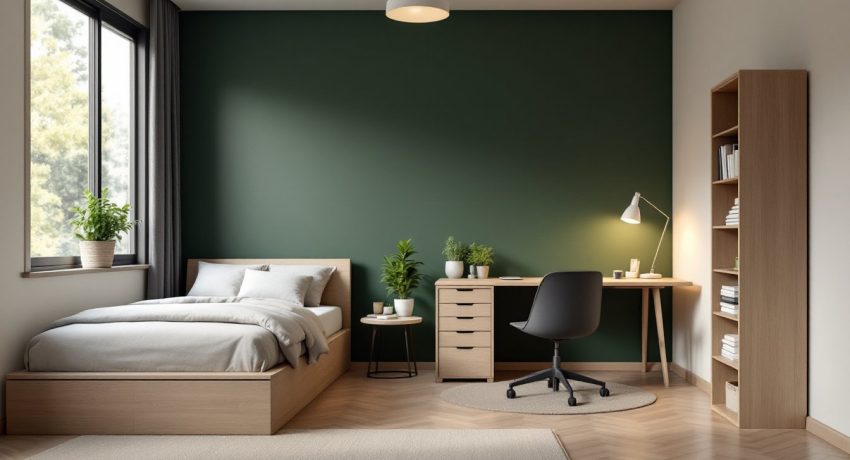
Paint one accent wall behind your desk in a slightly darker or more saturated color, forest green, deep blue, warm gray, or muted burgundy. Leave the rest of the room in a softer, lighter tone. This creates visual depth and anchors the office zone without overwhelming the space. One gallon of paint covers roughly 350 to 400 square feet: you’ll use a fraction of that for an accent wall, costing $20 to $50.
Flooring or floor rugs can define zones too. If your bedroom has hardwood or laminate, a soft area rug under the bed and a different low-pile or anti-fatigue mat under your desk chair creates tactile and visual separation. The office rug prevents chair wheels from catching on carpet (if you have it) and marks the boundary of the work zone. Rugs run $50 to $300 depending on size and quality.
Decor and accessories reinforce the zones. Keep the bed side minimal and restful, a nightstand, a lamp, maybe a piece of art. Stack books, storage boxes, and reference materials on your desk side. The contrast in visual density tells the eye “this half is for work, that half is for rest.” Minimalist desktop organizers, document trays, and storage boxes ($15 to $50) keep the work zone functional without looking like a filing system exploded.
Plants deserve their own mention. A tall plant near your desk adds life and filters air: a small succulent on the nightstand adds softness. Plants also muffle sound slightly, so they’re functional and beautiful.
Consider that romantic bedroom designs emphasize calm, restful aesthetics, principles worth borrowing for your sleep side, even in a combo space. The contrast between serene and purposeful zones makes both feel more authentic.