
Building a modern wine cellar doesn’t mean you need a sprawling mansion or a bottomless budget. Today’s homeowners are creating sophisticated wine storage solutions in basements, closets, and repurposed corners, spaces that look gallery-worthy while protecting their collections. Whether you’re storing a modest handful of bottles or building toward a serious collection, the design principles remain the same: temperature stability, proper humidity, subtle lighting, and a layout that’s both functional and inviting. This guide walks you through contemporary cellar designs, climate control systems, display strategies, and cost-effective storage options that work for real homes.
Table of Contents
ToggleKey Takeaways
- Modern wine cellar ideas prioritize temperature stability (45–65°F ideally), proper humidity (50–80%), and minimal light exposure to protect your collection, whether you’re storing a few bottles or building a serious reserve.
- Contemporary cellar designs emphasize clean lines, efficient vertical spacing, and mixed storage (open shelving with closed cabinetry) that integrate seamlessly into your home while keeping bottles accessible and visually organized.
- Wine-specific cooling units like WhisperKool or CellarPro outperform standard HVAC systems in energy efficiency and humidity control, though smart thermostats and hygrometers ($30–$100) add affordable automation to prevent costly bottle loss.
- LED strip lighting in warm tones (2700K) is the modern standard for wine cellars, providing enough visibility to read labels without heat damage, and can be installed DIY for under $100 using simple dimmers.
- You can build a functional wine cellar for $2,000–$4,000 by combining a budget-friendly steel modular rack system, basic insulation, a quality humidifier or mini-split unit, and LED lighting—skipping expensive hardwood cabinetry and luxury finishes.
Contemporary Cellar Designs That Balance Aesthetics and Function
Modern wine cellars differ sharply from dusty basement racks and dark wooden cabinets. Today’s approach emphasizes clean lines, materials that age well, and layouts that make browsing and accessing bottles intuitive. The best designs don’t shout “wine room”, they integrate seamlessly into the home’s overall aesthetic while doing their job quietly and reliably.
Function drives form in a well-planned cellar. You’ll want to account for bottle orientation (horizontal or at a slight angle to keep corks moist), accessible racking heights, and sightlines that let you find what you’re looking for without moving three other bottles first. The visual weight of hundreds of bottles can overwhelm a small space, so smart design breaks the collection into zones and uses contrast, light walls against dark bottles, open shelving mixed with closed storage, to create visual rhythm.
Minimalist Wine Cellars for Small Spaces
Small-space cellars thrive on restraint. A dedicated closet, an alcove under the stairs, or even a section of a finished basement can hold 100–300 bottles without feeling cramped if you plan vertically and choose simple materials. Think concrete-effect flooring, white or soft gray walls, and stainless steel or powder-coated metal racking.
Experiences shared across design platforms like Dwell show that the most successful compact cellars use every inch efficiently: floor-to-ceiling racking, adjustable shelves that accommodate different bottle sizes, and minimal decorative clutter. A single LED strip running along the top or integrated into shelving adds ambient light without heat buildup. Avoid oversized cabinetry, frameless glass doors on a small cabinet holding 50–80 bottles can look more sophisticated than a wall of heavy wood.
If your space is tight, skip the tasting table and comfortable seating: instead, install a small countertop for note-taking or a slim side table. The cellar’s job is storage and display: if you entertain, bring bottles upstairs.
Industrial and Modern Aesthetics
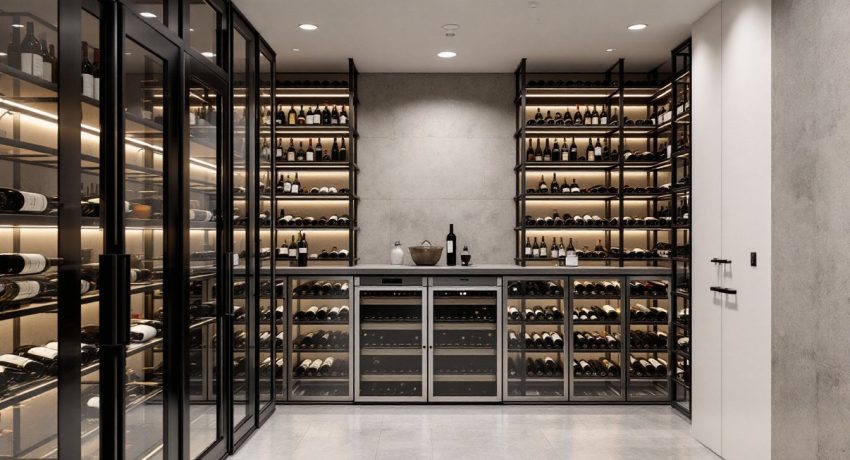
Industrial cellars lean into raw materials: exposed brick or concrete walls, steel pipe racking, polished concrete or sealed concrete floors, and Edison-style bulbs. These designs work especially well in loft conversions, finished basements with visible joists, or properties with genuine vintage bones. The aesthetic is intentional, not accidental, think gallery more than warehouse.
Stainless steel wine racks, metal-frame shelving, and matte black finish hardware age gracefully and resist corrosion better than painted finishes in humid environments. Pair them with reclaimed wood shelving or sleek glass shelves depending on your vibe. A focal point, a feature wall in contrasting tile, exposed stone, or even carefully positioned lighting, prevents the space from feeling clinical.
Beware of over-styling industrial spaces. A single large mirror or framed art installation works: covering the walls with vintage signs or wine-themed décor tips into cliché. Let the materials and bottles themselves be the visual interest.
Climate Control Solutions for Wine Storage
Temperature stability is non-negotiable. Fluctuations damage wine faster than a single warm spell, they cause expansion and contraction of the liquid and cork, letting oxygen seep in. You’re aiming for 45–65°F, ideally around 55°F, with humidity between 50–80% and minimal light exposure.
If your cellar space is insulated and in a naturally cool zone (below-grade basements in cool climates, for example), you might get away with a basic thermostat and humidifier. But most homeowners need active cooling. Here’s where you’ll make your biggest investment, and it’s worth doing right.
Smart Cooling Systems and Temperature Monitoring
Wine-specific cooling units, brands like WhisperKool, CellarPro, or Vino Grotto, are purpose-built for wine storage. They’re quieter, more energy-efficient, and include humidity control compared to standard HVAC or air conditioning. Capacity ranges from 3,000 to 20,000 BTU for residential cellars: calculate your space’s volume and insulation level to right-size the unit.
Duct-based systems are more expensive but allow you to hide the equipment outside the cellar (in an adjacent room or attic). Passive systems (no ducts, unit installed in a wall opening or window) are cheaper and suitable for smaller spaces but can feel obtrusive. Most DIYers hire a technician for installation, it involves running electrical, possible structural cutting, and proper sealing to avoid air leaks.
Intelligent monitoring is a recent game-changer. Smart thermostats and hygrometers send alerts to your phone if temperature or humidity drifts out of range. Modern design resources increasingly highlight how automation keeps collections safe without constant manual checks. Units like Inkbird or generic WiFi sensors run $30–$100 and pay for themselves by preventing bottle loss.
Don’t skip insulation and vapor barriers. If your cellar shares a wall with uninsulated space, condensation and temperature swings will plague you. R-15 or R-20 insulation in walls and R-30+ in the ceiling are standard starting points, but your local climate matters, ask your HVAC tech or building inspector for guidance. Vapor barriers prevent moisture from migrating into wall cavities and causing mold.
Lighting and Display Ideas for Wine Collections
Lighting in a wine cellar serves two masters: it can’t damage the wine, but it must let you actually see the labels and appreciate the bottles. UV light degrades wine, so avoid direct sunlight and standard tungsten bulbs. LED strip lights in warm color temperatures (2700K) are the current standard, they generate minimal heat, consume little power, and provide enough light to read labels at typical viewing distances.
Mounted horizontally above shelving or tucked into the underside of a shelf, LEDs create a clean, modern look. Use dimmers to adjust intensity: you don’t need bright overhead lighting. Recessed downlights can work if positioned to avoid direct contact with bottles: angle them toward the surrounding wall or floor rather than straight down on the bottles.
Open shelving displays bottles like art, but it requires more frequent dusting and exposes bottles to ambient light. Glass-front cabinets or closed racking compromise visibility but offer better protection. Many modern cellars mix the two: open shelving for bottles you drink regularly or want to show off, closed storage for your reserve collection.
Labels facing out transforms a wine collection into a visual narrative. This requires racking or shelving designed for that orientation, horizontal racks with each bottle presented front-forward rather than stacked deep. It takes more space than traditional deep storage, so reserve it for bottles you want people to notice. Consider a small accent wall or display case as a focal point: platforms from luxury design publications often feature curated collections in precisely this way.
Wall color matters more than you’d think. Soft grays, warm whites, and muted greens provide a neutral backdrop that lets bottles stand out without competing. Dark walls can feel cave-like: too-bright white can feel clinical. Paint finishes matter too, matte or eggshell resists the humid environment better than glossy.
Budget-Friendly Wine Storage Solutions
You don’t need to spend five figures to store wine properly. A basement corner with DIY racking, basic climate control, and thoughtful lighting beats an expensive setup in the wrong location.
Racking and Storage Options: Wine racks range from $2 per bottle (modular plastic or wire systems) to $50+ per bottle (hardwood or luxury metals). For 100 bottles, a steel modular rack system ($800–$1,500) handles temperature and humidity swings better than wood. Pallets, PVC pipe, and repurposed shelving can work short-term, but they don’t age well in humid cellars and eventually warp or corrode.
Stacking systems designed specifically for wine (Vinotemp makes affordable options) start around $200–$400 for 20 bottles. They’re not pretty, but they work and can be tucked into a closet.
Climate Control on a Budget: If you’re in a cool climate (northern states, high elevation) and your cellar space is already insulated and below grade, a quality humidifier and thermostat (combined $300–$500) might be enough. A basic mini-split HVAC unit runs $1,500–$3,000 installed and handles small-to-medium cellars. Compare that to a wine-specific cooler at $2,000–$5,000-plus, and the trade-off is noise and flexibility, mini-splits aren’t silent, but they cool a whole room and aren’t dedicated to wine.
Insulation: If your walls aren’t insulated, budget $1–$3 per square foot for blown-in insulation (assuming DIY: hire a pro if you’re uncomfortable accessing wall cavities). This prevents temperature swings and reduces cooling load, which saves money on electrical bills over time.
Lighting: LED strip lights from hardware stores run $15–$40 per 16-foot roll. Install them yourself with adhesive or screws, wire them to a simple dimmer switch ($10–$20), and you’ve added professional-looking ambient light for under $100 total.
Building Codes and Permits: Wine cellars are typically not separately permitted in residential homes, they fall under general remodeling or room conversion rules. But, if you’re modifying HVAC, running new electrical circuits, or making structural changes, permits may apply depending on your jurisdiction. A short conversation with your local building department saves headaches later. Check that your cooling system installation doesn’t require a licensed HVAC contractor in your state (many states now do).